Almost every conversation about AI-built software assumes the question is whether the code will eventually be good enough. It will be. The more interesting question is what happens between now and then - and whether the answer changes when "then" arrives.
Two Curves, Side By Side
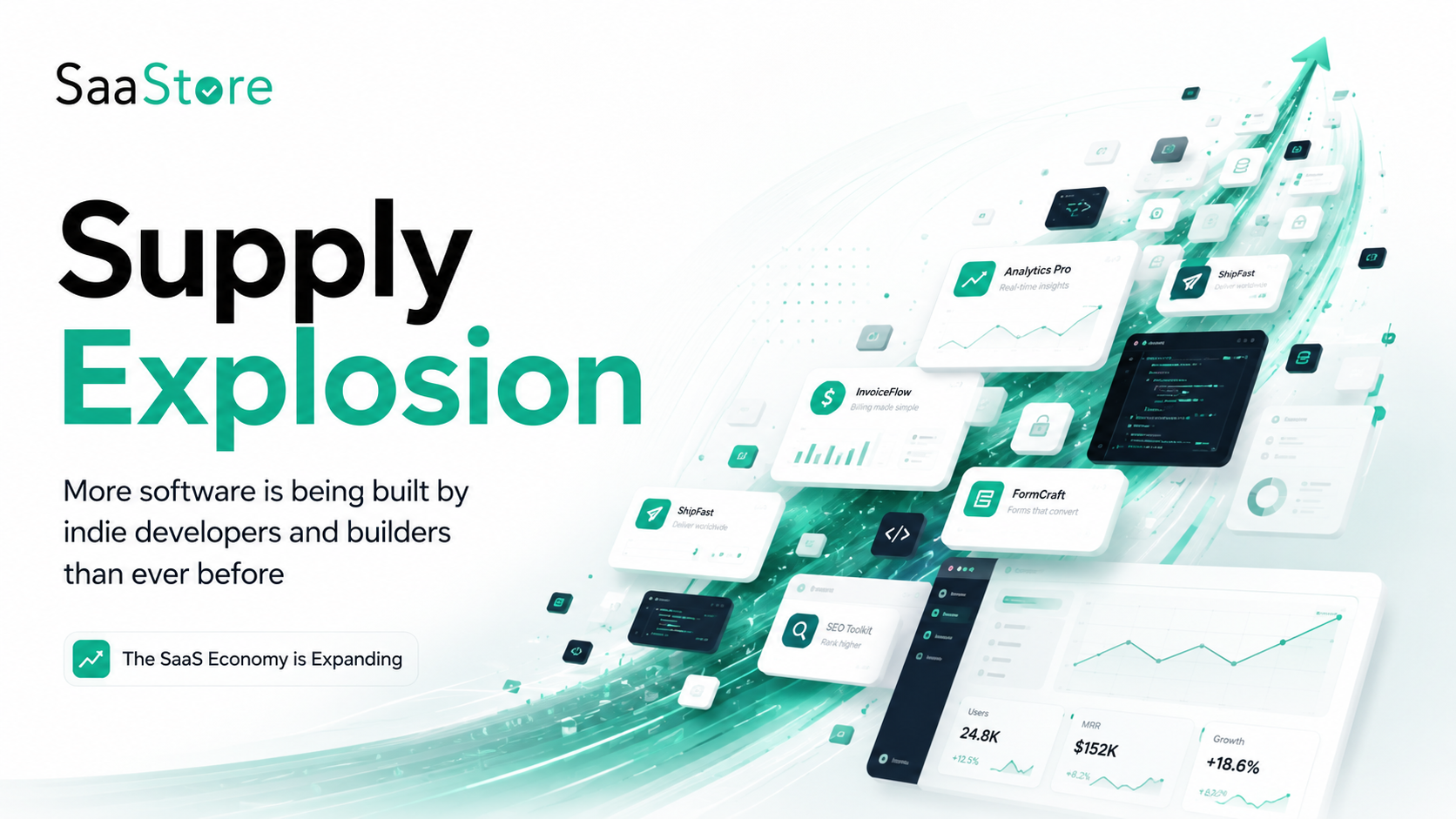
Supply, today: tens of millions of indie and AI-built apps in production, with hundreds of thousands more arriving each quarter (Apple data alone). The growth rate is linear-to-exponential through 2028, with Deloitte projecting 100 million citizen developers by then and Gartner forecasting 75% of new applications built via low-code by 2026.
Quality, today: 45% of AI-generated code carries security vulnerabilities (Veracode 2025), with the figure stable across model generations. Buyer trust in AI accuracy is at 29% and falling (Stack Overflow 2025). Roughly one in three indie SaaS products either disappears, pivots, or stops getting updates within a year (AppSumo cohort data).
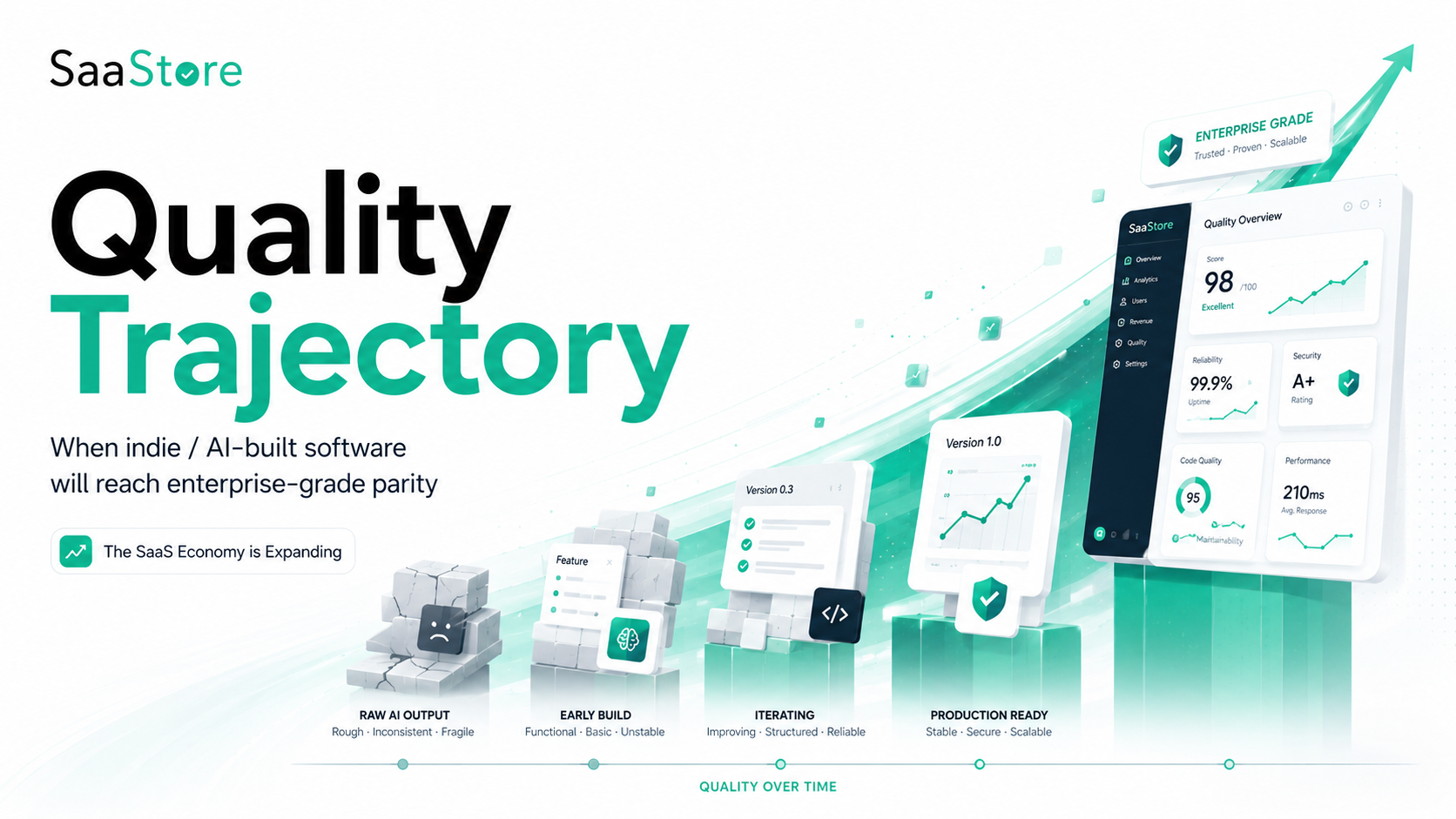
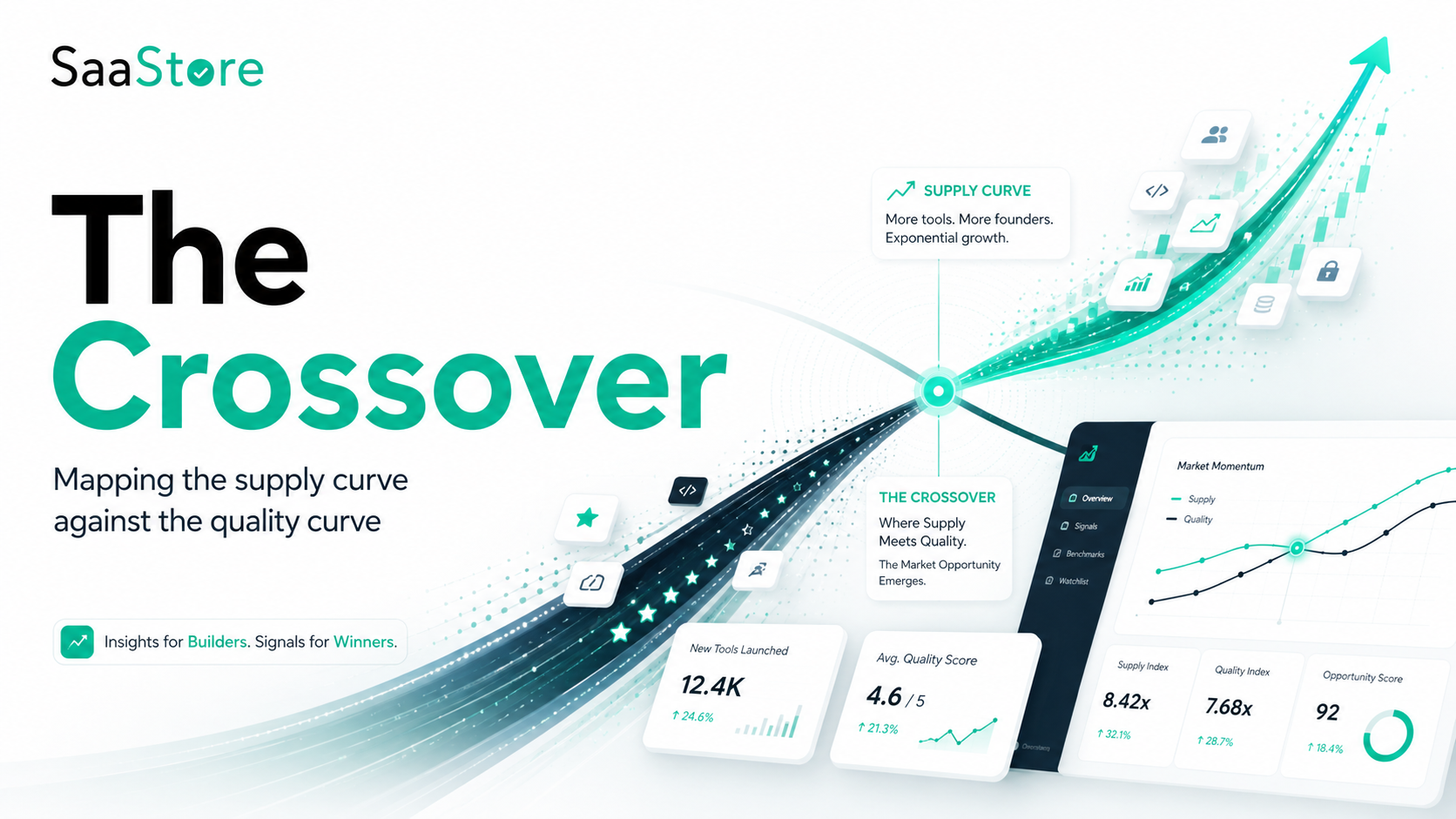
Supply is going up. Quality is roughly flat. The gap between the two curves is where every buying decision currently gets made.
When Do The Curves Meet?
Forecasts diverge. The optimistic case - Anthropic's "powerful AI in late 2026 / early 2027," OpenAI's 2028 target for an autonomous AI researcher, the AI 2027 forecast's mid-2027 "superhuman coder" - puts broad enterprise-grade parity within two to three years. The sober case - METR's randomised trial findings, Karpathy's "5-10x pessimistic" framing, the Eli forecaster at the AI Futures Project - pushes the date out to 2028 or early 2030s.
For the purposes of a buying decision, the spread doesn't matter much. Either way, the next two to four years are a period in which supply has already exploded and quality has not yet caught up. That is the acute window.
The Quieter Insight
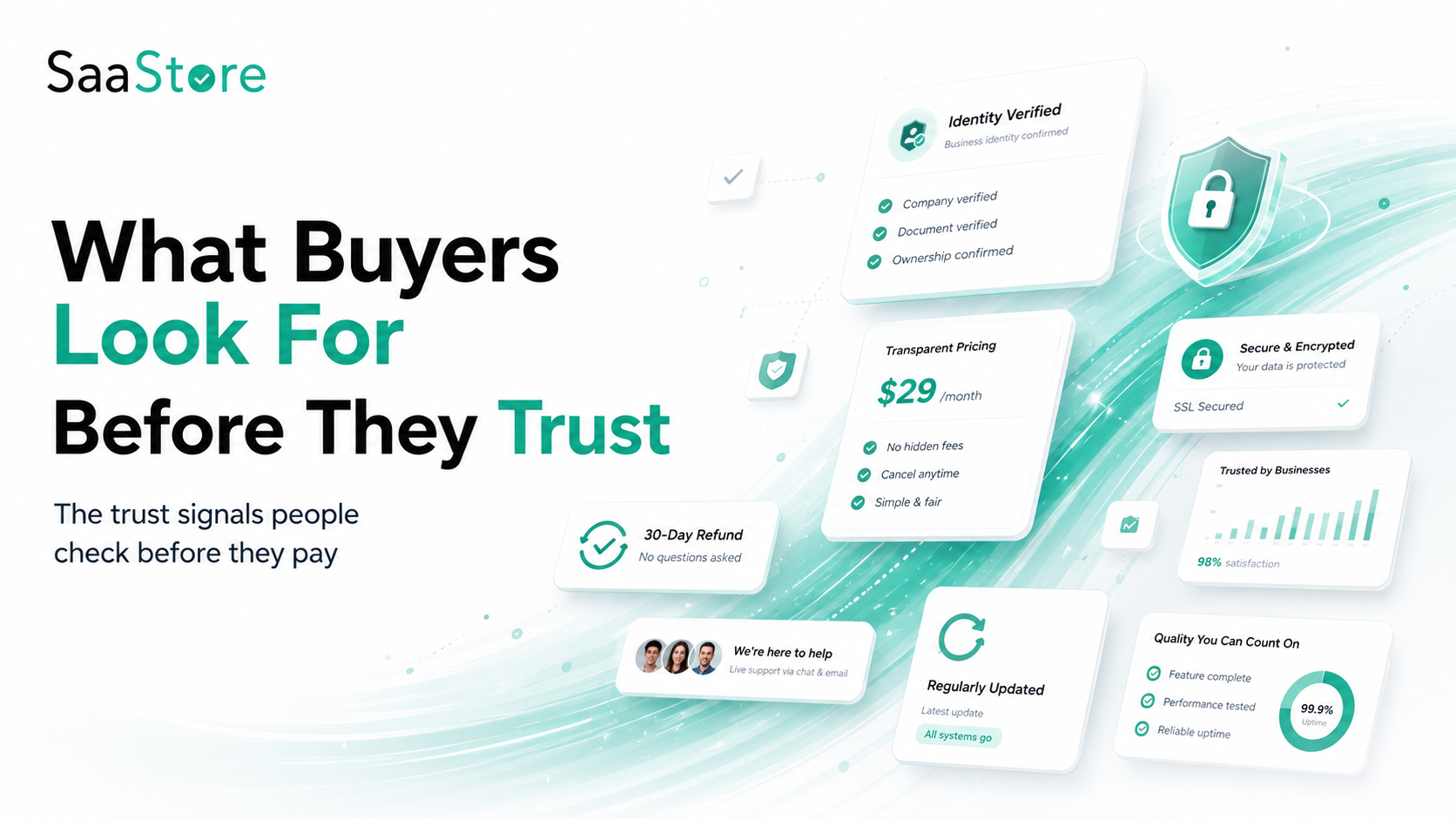
Even if you collapse the forecast to its most optimistic point and assume AI code quality reaches enterprise parity tomorrow, the story doesn't close. Code quality is one of five dimensions of buyer trust. The other four - vendor stability, subscription honesty, support guarantees, and recourse - are not solved by better AI. They are properties of the transaction relationship, not of the code.
A buyer asks five questions, not one:
- Does the product work and is it safe?
- Will the seller still exist in six months?
- Is the subscription cancellable honestly?
- Will support respond when something breaks?
- Is there any recourse if it all goes wrong?
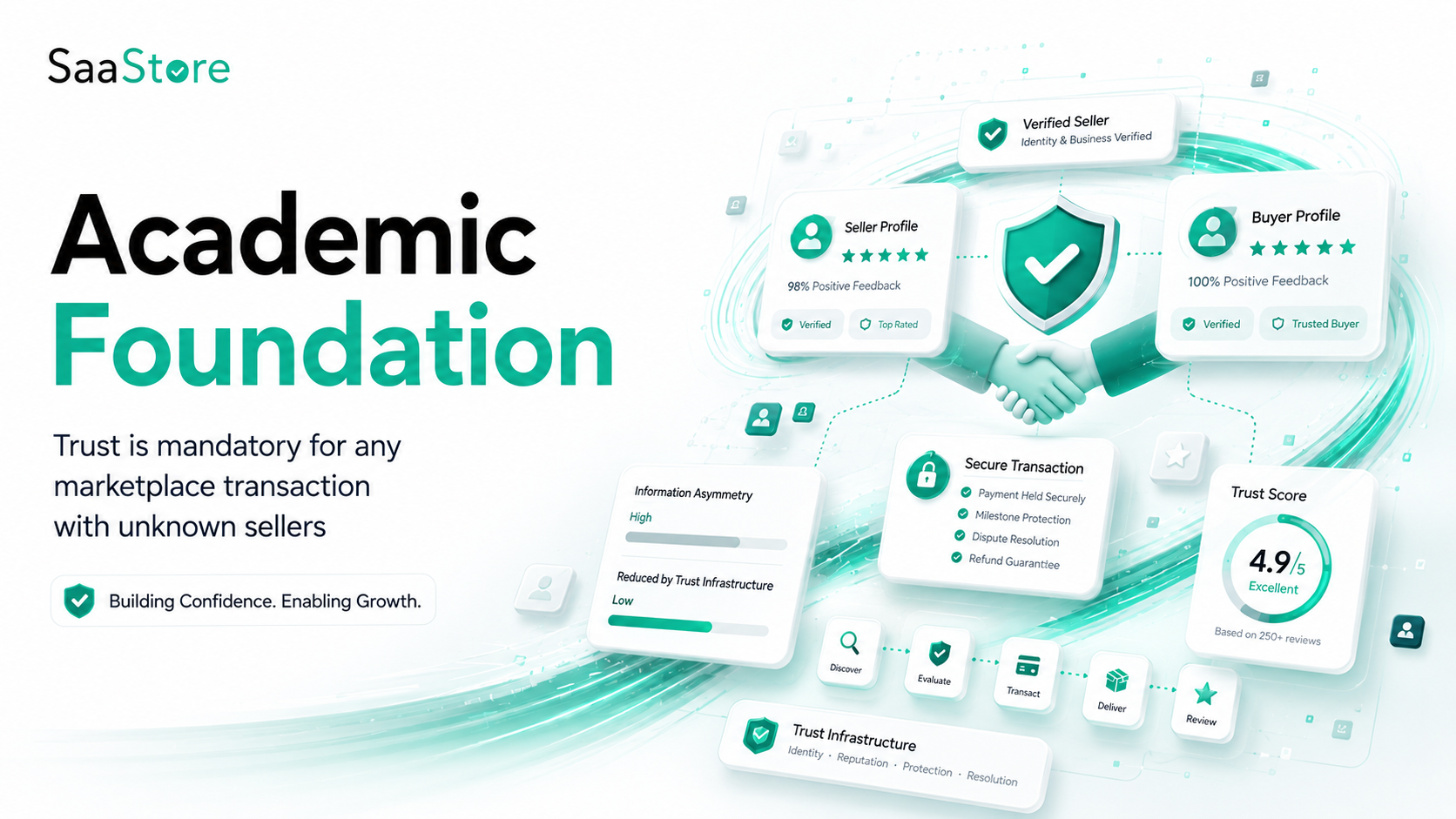
Better AI improves the first answer. It improves none of the others. Those are institutional questions - exactly the questions that historical marketplaces (eBay, Airbnb, Steam) answered with feedback systems, reputation data, and dispute resolution.
The 6sense Data Point
Empirical confirmation arrives from the 6sense 2025 Buyer Experience Study, roughly 4,000 respondents plus a 766-person follow-up. Across 2024 and 2025, 94% of B2B buyers were using LLMs in their research process. The median number of interactions per vendor stayed at 16 - statistically unchanged from 2023's 17 and 2024's 16. Generative AI did not reduce buyer reliance on direct vendor contact, third-party validation, or peer review.
The study's explicit finding: "GenAI is not yet at a stage where it can be fully trusted to guide purchases of $200,000 to $300,000." The structural prediction is that it won't be in 2027 or 2030 either - because verification is about counterparty risk, not technical correctness.
What Stays True Either Way
Two things hold regardless of how the AI quality curve actually moves:
- In the near term: code quality is genuinely poor and the cost of getting it wrong is concrete (PII leaks, failed payments, vanished sellers). Curation, independent review, and seller verification are the only mechanisms that bridge the gap.
- In the long term: even excellent AI-generated code does not solve buyer counterparty risk. Vendor disappearance, refund honesty, support, and recourse are institutional questions, not technical ones. They will need institutional answers in 2030 as much as in 2026.
The window where supply has outrun quality is the window in which the trust layer for AI-built software gets established. It does not stay open indefinitely. It is open now.